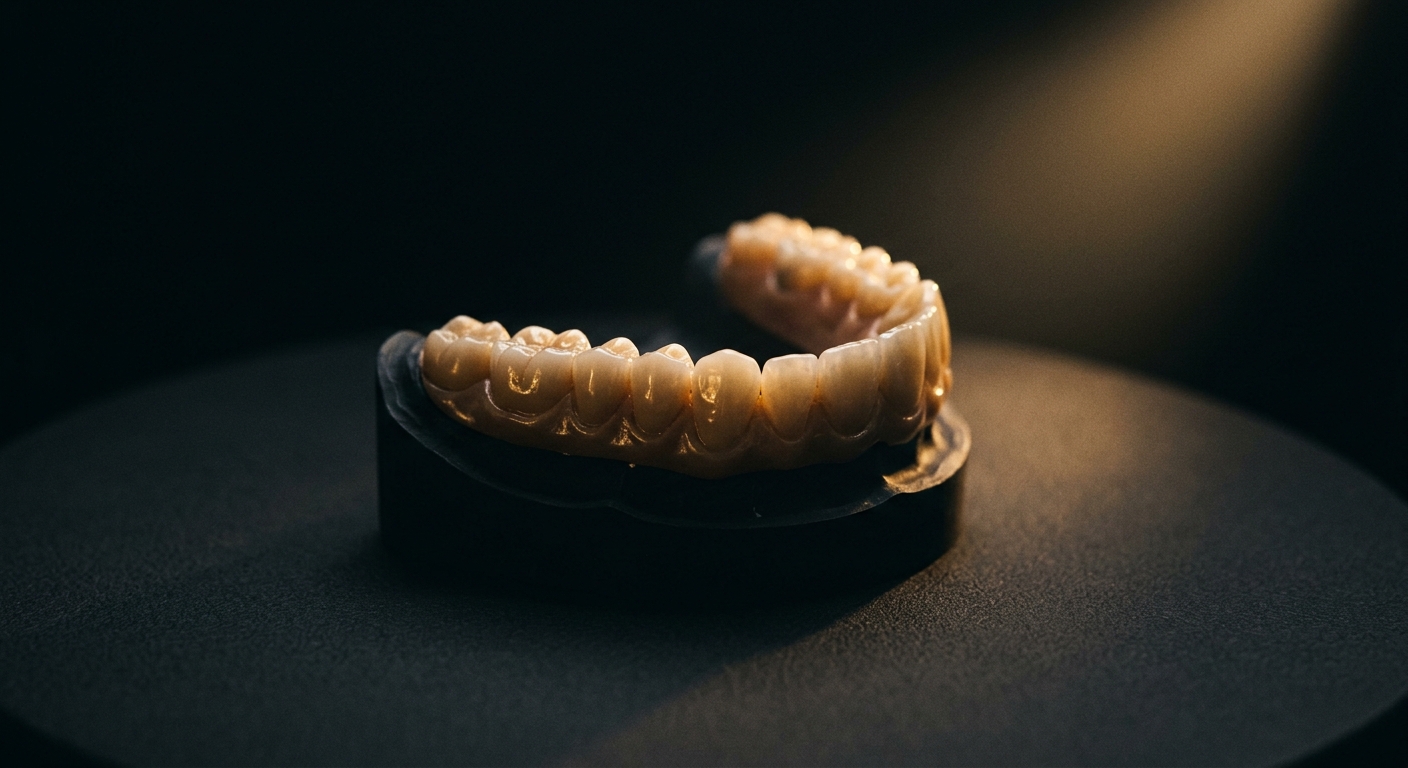
Twenty years ago an implant was placed by an experienced pair of hands reading a flat x-ray. Today the position is decided in software days beforehand and carried into the mouth by a printed guide. The difference is not marketing. It is how much is left to chance.
What guided actually means
A cone-beam scan takes a three-dimensional record of your jaw: bone height, bone width, the path of the nerve, the floor of the sinus. An intraoral scan records the teeth and gums on top of it. The two are merged into one model, and the implant is placed in that model first, on a screen, with the finished crown already drawn where it needs to end up.
Only then is a guide printed. It seats on your teeth in exactly one position, and it holds a metal sleeve that fixes the angle and depth of the drill. On the day, the plan is not remembered or estimated. It is physically constrained.
The plan is made in software, not in the chair
Most of the work of a guided case happens before you arrive. It is unglamorous and it is the reason the appointment is short.
- Merge the scansThe cone-beam volume and the intraoral scan are aligned into a single model, accurate to a fraction of a millimetre.
- Place the crown firstWe position the finished tooth where it belongs aesthetically, then work backwards to where the root must sit to support it.
- Check the anatomyNerve, sinus and adjacent roots are measured with real clearances, not eyeballed against a flat film.
- Print and verifyThe guide is printed and seated on a model before the day, so nothing about its fit is a surprise in your mouth.
Why it matters to you, not just to us
Patients do not care about software. What they notice is that the appointment is shorter, that the flap is smaller or absent altogether, and that the crown fitted months later does not need to be argued into position because the root was placed where the crown wanted it.
There is a quieter benefit too. When the plan is fixed in advance, the conversation with you happens in front of the screen days earlier, unhurried, with the option of saying no while nothing has begun.
Where guided surgery does not help
It is not a substitute for judgement or for hands. A guide places the implant where the plan says, which is only useful if the plan is any good. It cannot compensate for insufficient bone, uncontrolled gum disease, or a bite that will overload the restoration within a year.
It also has limits at the very back of a mouth that does not open widely, where the guide and drill assembly need room to seat. In those cases we plan digitally and place freehand with the plan on the screen beside us, which is still a long way from guessing.