A missing tooth, quietly made whole
An implant replaces the root as well as the crown, so the teeth on either side are left untouched and the bone beneath keeps its support. Planned in 3D and placed through a guide, it is the single-tooth result that ages best.
- Guided placement planned in 3D
- Hand-crafted, shade-matched ceramic crown
- Neighbouring teeth left fully intact
- A result built to last decades
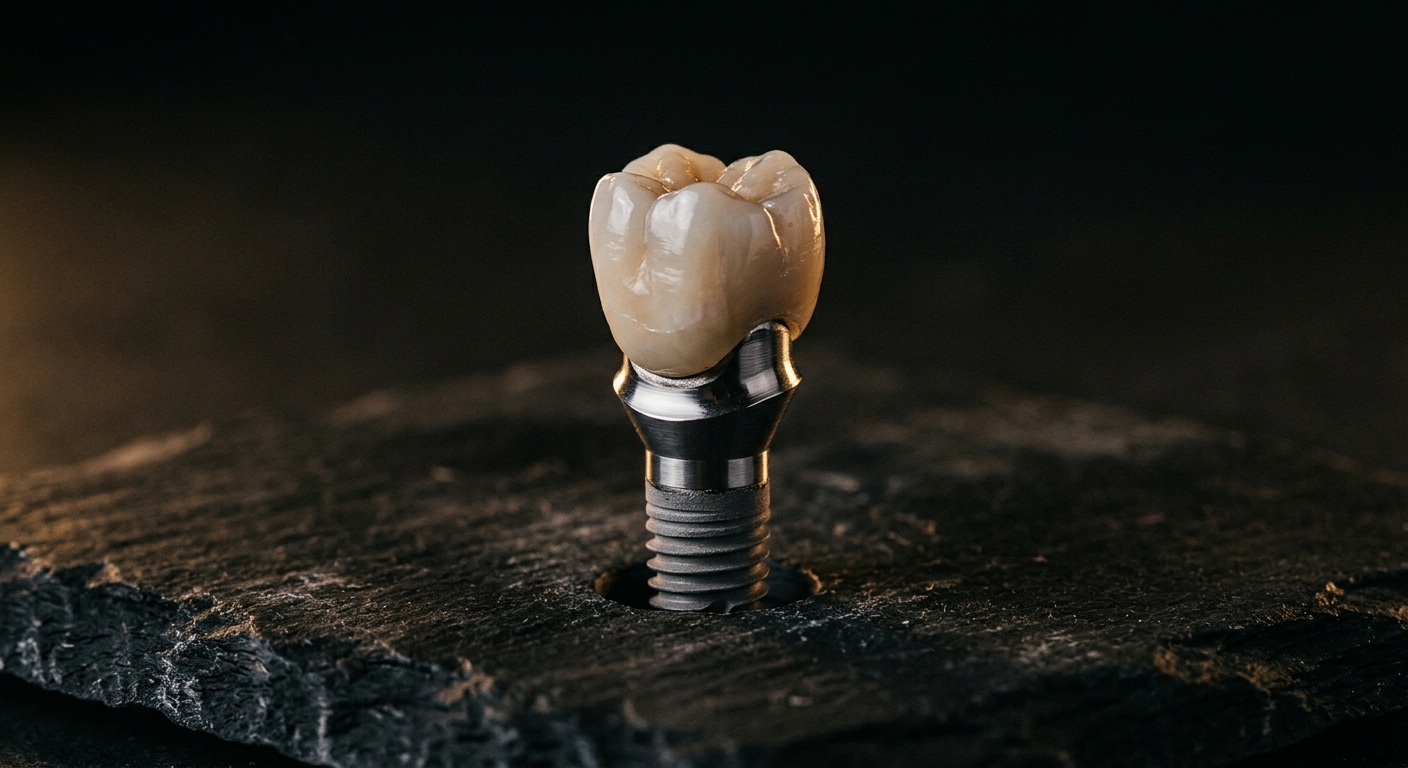
Planned before it is placed
Every implant here begins on a screen. A cone-beam scan maps your bone in three dimensions, and Dr. Rousseau designs the exact position, angle, and depth before you are ever in the chair. A printed surgical guide then carries that plan to the millimetre, which is what turns a surgical procedure into a calm, predictable one.
Once the titanium root has integrated with the bone over a few months, we craft the crown. It is milled, then hand-glazed and characterised to match the translucency and shade of the teeth around it, so the finished tooth reads as one of your own rather than a replacement.
Why the root matters
A bridge sits on top of the gum and leans on the teeth beside the gap, which have to be reduced to carry it. An implant asks nothing of its neighbours. It also preserves the bone that a missing root would otherwise let slowly recede, keeping the shape of your face and your bite intact. For most single-tooth gaps, that is the difference between a repair and a genuine restoration.
From scan to finished tooth
An implant is not one appointment, it is a short series of unhurried ones. Here is the shape of the whole thing, so nothing arrives as a surprise.
The 3D consultation
We scan your bite and your bone in three dimensions, review the images with you on the screen, and confirm that an implant is genuinely the right answer for your gap.
The plan and the guide
Dr. Rousseau designs the position, angle and depth digitally, then a surgical guide is printed from that plan. Nothing about placement day is improvised.
Placement, in about an hour
The titanium root is placed through the guide under local anaesthetic, with sedation available. Most patients describe it as quieter and shorter than they expected.
Healing, then the crown
Over roughly three to four months the bone integrates with the root. Then we craft, glaze and fit the crown, matched to the teeth on either side.
Implant, bridge, or partial
Three honest ways to fill a single gap, compared the way we would compare them with you in the chair.
| Single implant | Fixed bridge | Removable partial | |
|---|---|---|---|
| Neighbouring teeth | Left completely intact | Reduced to carry the bridge | Clasped, and worn over time |
| Bone underneath | Kept loaded and supported | Recedes under the gap | Recedes under the gap |
| Feels like | A tooth you forget about | Fixed, but joined to its neighbours | Removed nightly |
| Typical lifespan | Decades with good hygiene | Around ten to fifteen years | Five to eight years |
| Investment | Highest at the start | Moderate | Lowest at the start |
Illustrative comparison for a demo practice. Your own options depend on your bone, bite and health, and are discussed before anything begins.
Questions
about
this care
Let us look at it properly
A $99 welcome visit covers a full exam, 3D imaging and a hygiene cleaning, and becomes the foundation of your written plan.