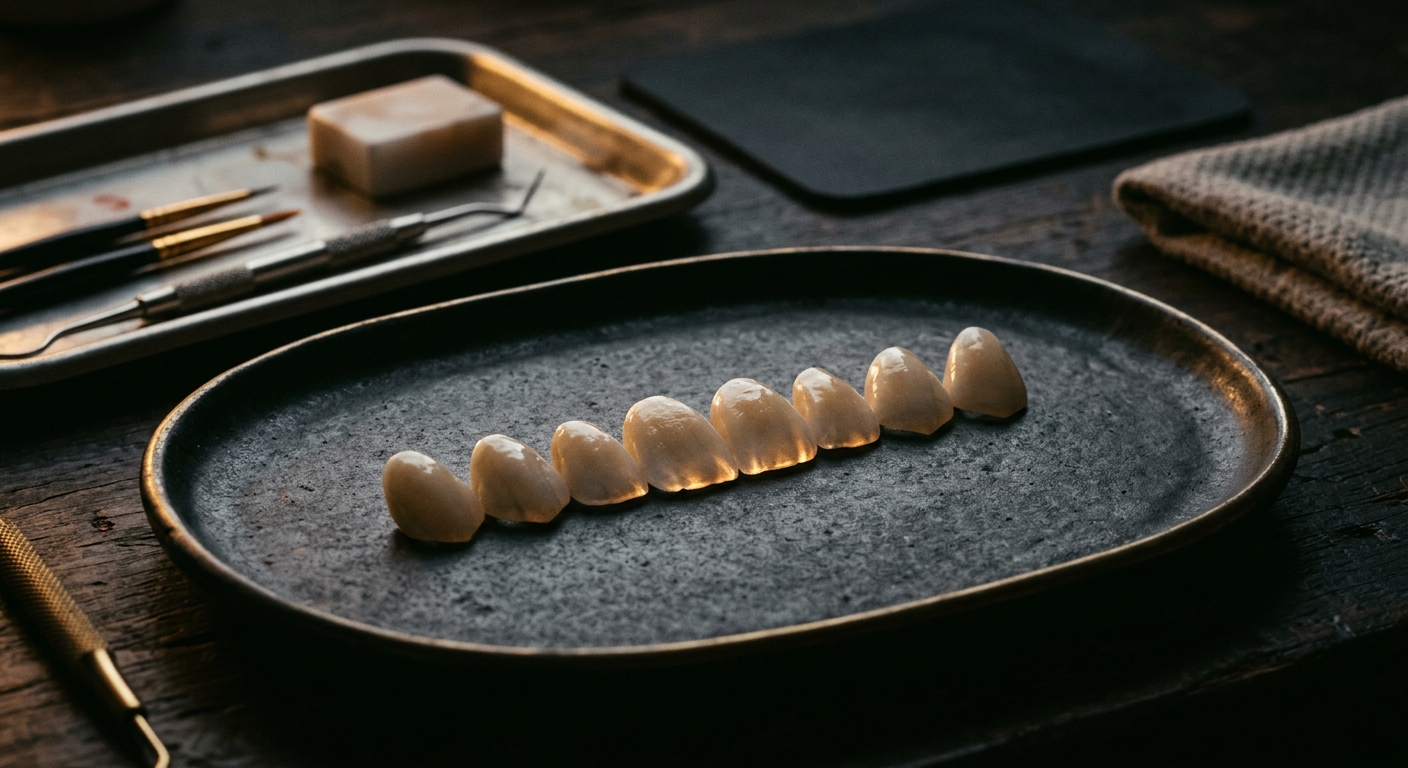
The first instrument we pick up in a cosmetic case is a camera. Not for the website, and not for a before-and-after wall. Photographs are the only way to study a smile in the light and the movement it actually lives in.
Why we photograph before we treat
An examination shows us teeth in a mouth held open under a bright overhead lamp, which is the one lighting condition your smile will never be seen in. A photographic session shows us the smile as other people meet it: at rest, mid-sentence, in a full unguarded laugh, from slightly off-axis, in soft light.
Half of what we learn is invisible in the chair. How much upper tooth shows when the face is relaxed, whether the smile line follows the lower lip or fights it, which side of the mouth does the working, how much gum appears at full smile. Every one of those changes the design.
Light is a diagnostic tool
Enamel is translucent, so it does different things in different light. Cross-polarised images strip the surface reflections away and show the colour map underneath: where the dentine is warmer, where old white spots sit, where a crack runs. Ordinary images, taken with a soft box to one side, show the surface texture that makes a tooth catch light.
A shade is not a number on a tab. It is a behaviour, and you can only judge it by watching light move across a tooth.
The ceramist who builds your veneers never meets you. Those photographs are how they do meet you, and the difference between a good set and a great one is very often the quality of what we sent to the bench.
The session, step by step
- Face at restLips relaxed, no smile. This tells us how much tooth shows when you are not performing, which is most of your life.
- Speaking framesA few words on camera. The lip moves differently in speech than in a held smile, and edges that look right in a still can look wrong in motion.
- Full smile, several anglesStraight on and off-axis, so we can see the arch curve rather than only the front six.
- Close detail and cross-polarRetracted detail images and a polarised pass for the colour map, sent straight to the ceramist with the design.
It is done once, it takes about twenty minutes, and it becomes the reference for every decision afterwards. If we change something later, we change it against those images rather than against a memory of your face.
What we do with the images
The design is drawn over your own photographs, so what you approve is your face with a proposed smile in it rather than an abstract diagram. That is also the point at which most useful changes get made, because seeing your own face makes an opinion easy to form and easy to voice.
At the end of treatment we shoot the same frames again, in the same light. Not for marketing, though patients often ask for copies. It is the only honest way to judge whether we did what we said we would do.